
Wikimedia Commons
How Telescopes Work
How Telescopes Work
Telescopes are tools that help us see things that are very far away. They collect more light than our eyes can and make distant objects look bigger. Without telescopes, we would know very little about the planets, stars, and galaxies. Telescopes have been helping scientists explore space for over 400 years.
Types of Telescopes
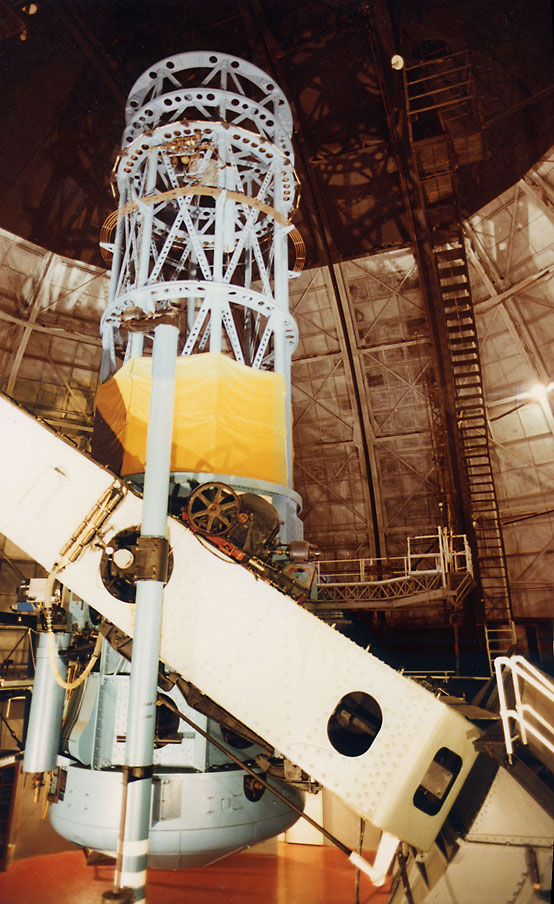
There are two main types of telescopes. A refracting telescope uses glass lenses to bend light and magnify objects. A reflecting telescope uses curved mirrors to bounce light and create an image. Most big telescopes at observatories use mirrors because they can be made much larger than lenses.
Why Bigger Is Better
A bigger telescope can collect more light. This lets you see fainter and more distant objects. A small backyard telescope can show you the rings of Saturn and craters on the Moon. The biggest telescopes on Earth can see galaxies billions of light-years away. Space telescopes work even better because they are above Earth's blurry atmosphere.
More to Know
Telescopes were invented in the Netherlands in 1608. In 1609-1610, Galileo used a better one to see Jupiter's four largest moons, the phases of Venus, and mountains on the Moon. Newton built a mirror telescope around 1668. Big lenses sag, but mirrors can be supported from behind, so large telescopes use mirrors. The Hubble Space Telescope launched in 1990, and the James Webb Space Telescope launched on December 25, 2021, with an 18-segment gold-coated mirror about 21 feet across that sees infrared light from about a million miles away.
Fun Facts
- Galileo built one of the first telescopes used for astronomy in 1609.
- The biggest optical telescope mirrors are over 30 feet wide.
- Some telescopes can see light that is invisible to our eyes, like radio waves and X-rays.
Did You Know?
If your eyes were as powerful as the Hubble Space Telescope, you could read a newspaper from a mile away.

You finished the article! Great job!