
Wikimedia Commons
Simple Machines
Simple Machines
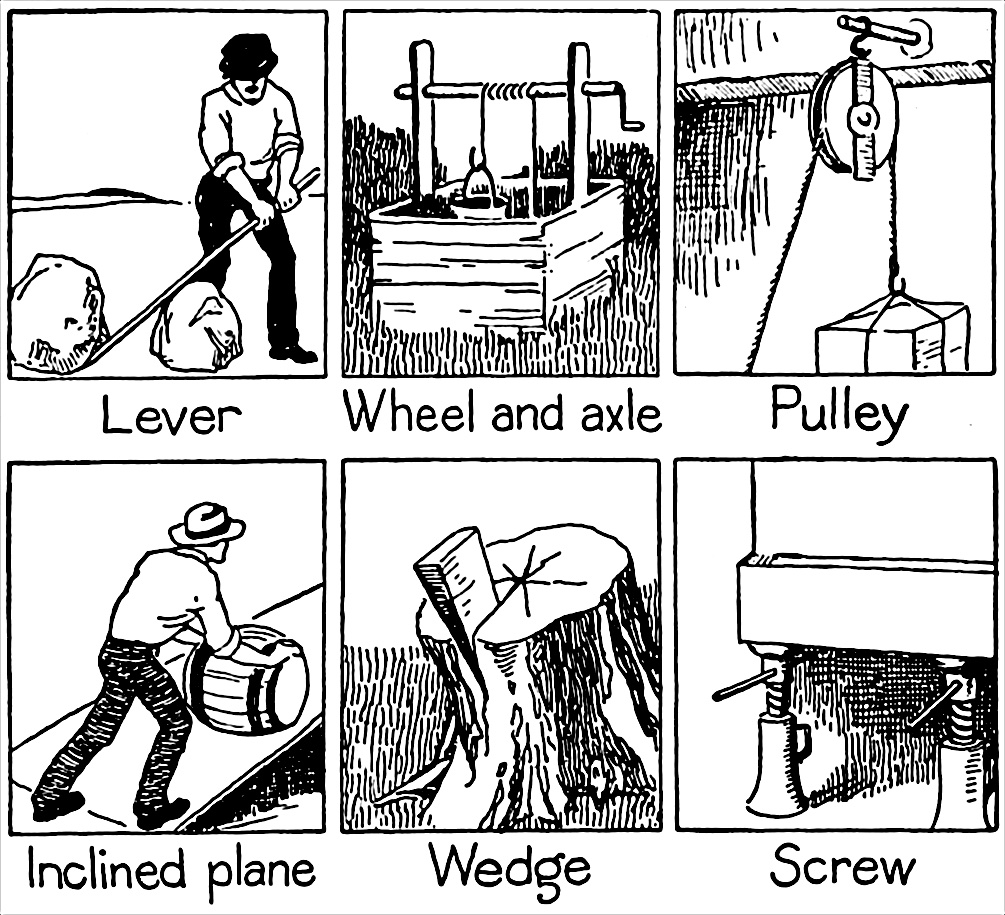
Simple machines are tools that help us do work. They have been used by people for thousands of years. There are six main simple machines. They include the lever, pulley, wheel and axle, inclined plane, wedge, and screw.
Why We Use Them
Simple machines make hard jobs easier. They let us lift heavy things without using as much strength. They can also help us move objects faster or farther. A seesaw is a kind of lever that kids use at the playground. Even scissors are made from two simple machines put together.
Machines All Around
Simple machines are everywhere in daily life. Door knobs, bottle openers, and ramps are all simple machines. When you put many simple machines together, you get a complex machine. Bicycles and cars are made of many simple machines working together. Learning about them helps us understand how things work.
More to Know
A force is a push or a pull, and friction is the force that slows things when surfaces rub together. Simple machines do not remove work; they trade distance for force. A longer, gentler ramp takes less push but more distance, and a lever lifts a heavy load with a small push over a longer motion around its fulcrum. A screw is a ramp wrapped around a post, a wedge pushes things apart, and a flagpole uses a pulley. A bicycle combines wheels and axles, levers (pedals), gears, and friction brakes.
Fun Facts
- The ancient Egyptians used simple machines to build the pyramids.
- A pair of scissors is made of two levers and two wedges.
- Your arm works like a lever when you lift something.
Did You Know?
A Greek scientist named Archimedes studied simple machines over 2,000 years ago and wrote about how they work.

You finished the article! Great job!