Wikimedia Commons
Measurement
Measurement
Will a bookmark fit inside your book? Guess first. Then measure its length. Measurement compares something with a chosen unit. A number alone is not enough: a strip that is "6 long" might mean six centimeters, six inches, or six small paper squares.
Make a Measuring Row
Choose equal paper squares. Use the width of one square as your length unit. Place the squares along a strip, with edges touching. Start at one end of the strip. Leave no gaps and do not overlap the squares. If six square-widths fit exactly from end to end, the strip is six of those units long.
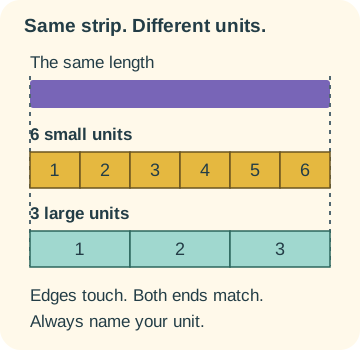
The strip in the picture has not changed. A larger unit gives a smaller count: three large units cover the same length as six small units. That is why we must name our unit!
If your last unit sticks past the end, do not claim that a whole number of units fits exactly. Choose another object for this whole-unit activity, or describe the leftover part with an adult.
A Ruler Is a Row of Equal Intervals
A ruler has marks separated by known lengths. On a centimeter scale, the distance from 0 to 1 is one centimeter. From 0 to 6 there are six centimeter intervals but seven numbered marks. Measure the spaces between the marks, not the number of marks.
Start at the zero mark, which may be a little way from the ruler's physical edge. If you start at the 2-centimeter mark and finish at 8, the length is 8 − 2 = 6 centimeters.
Choose What to Measure
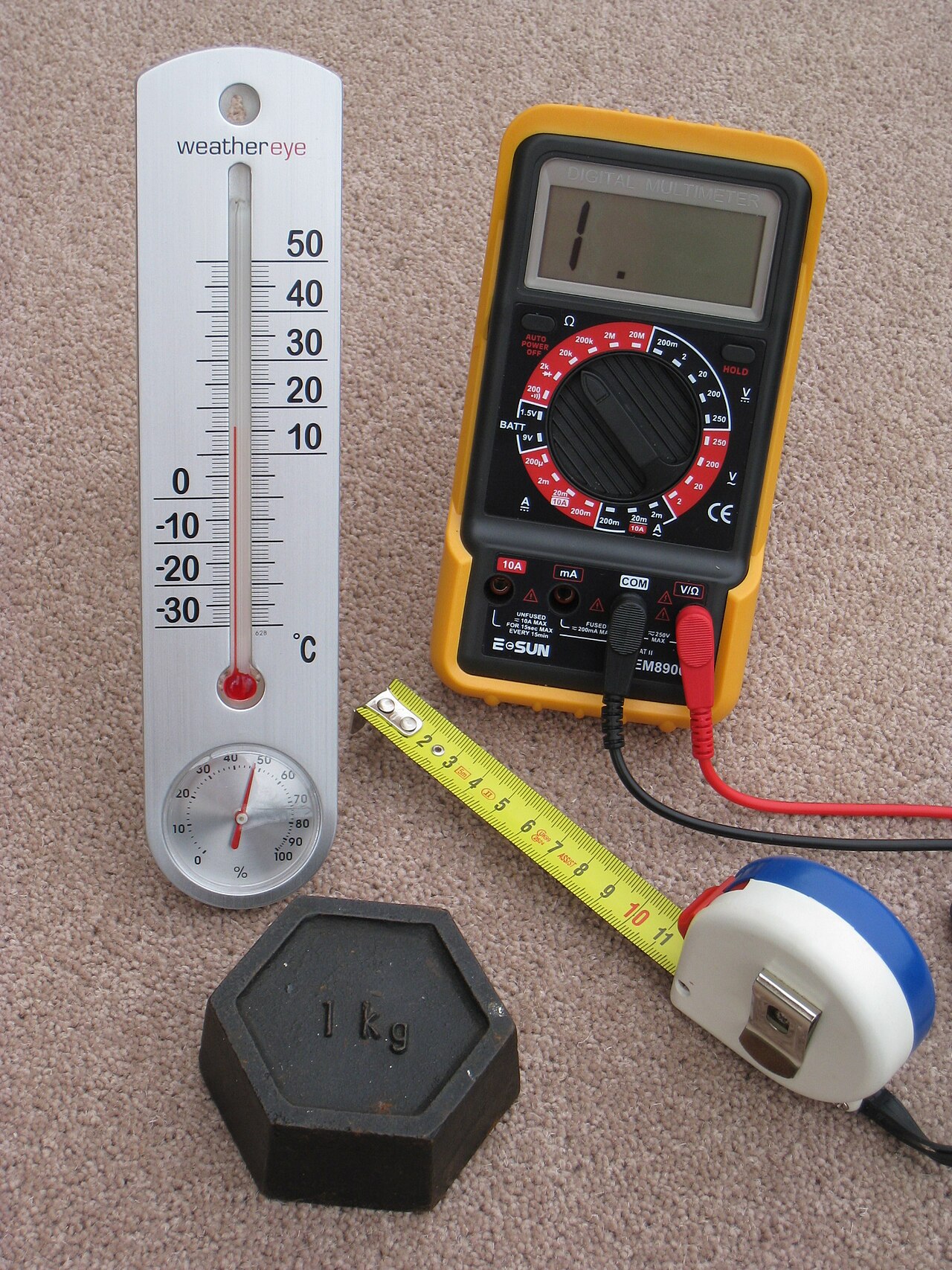
- Length: how far between two ends. Use a ruler or tape and units such as centimeters, meters, or inches.
- Mass: a measure of how much matter an object contains. Scales commonly report grams or kilograms. In everyday speech people often call this "weight." In science, weight is the force of gravity on an object.
- Volume: how much space something occupies. A marked jug can measure liquid volume in milliliters or liters.
- Elapsed time: how long an event takes. A timer can show seconds or minutes.
Use a tool and unit that fit your question. A ruler cannot tell you how long a song lasts!
Try It: Two Measuring Teams
Ask someone to measure the same book edge with you. First use hand-widths. Your results may differ because your hands are different sizes or you leave spaces. Now use the same equal paper units and agree on the two endpoints. Compare your results again.
Centimeters and inches have agreed sizes, unlike people's hands. Shared standard units help someone else understand your measurement without borrowing your paper squares.
Try the Measure with Equal Units lesson. Build a measuring row and fix gaps, overlaps, and unequal pieces.
You finished the article! Great job!