
Wikimedia Commons
Fractions
Fractions
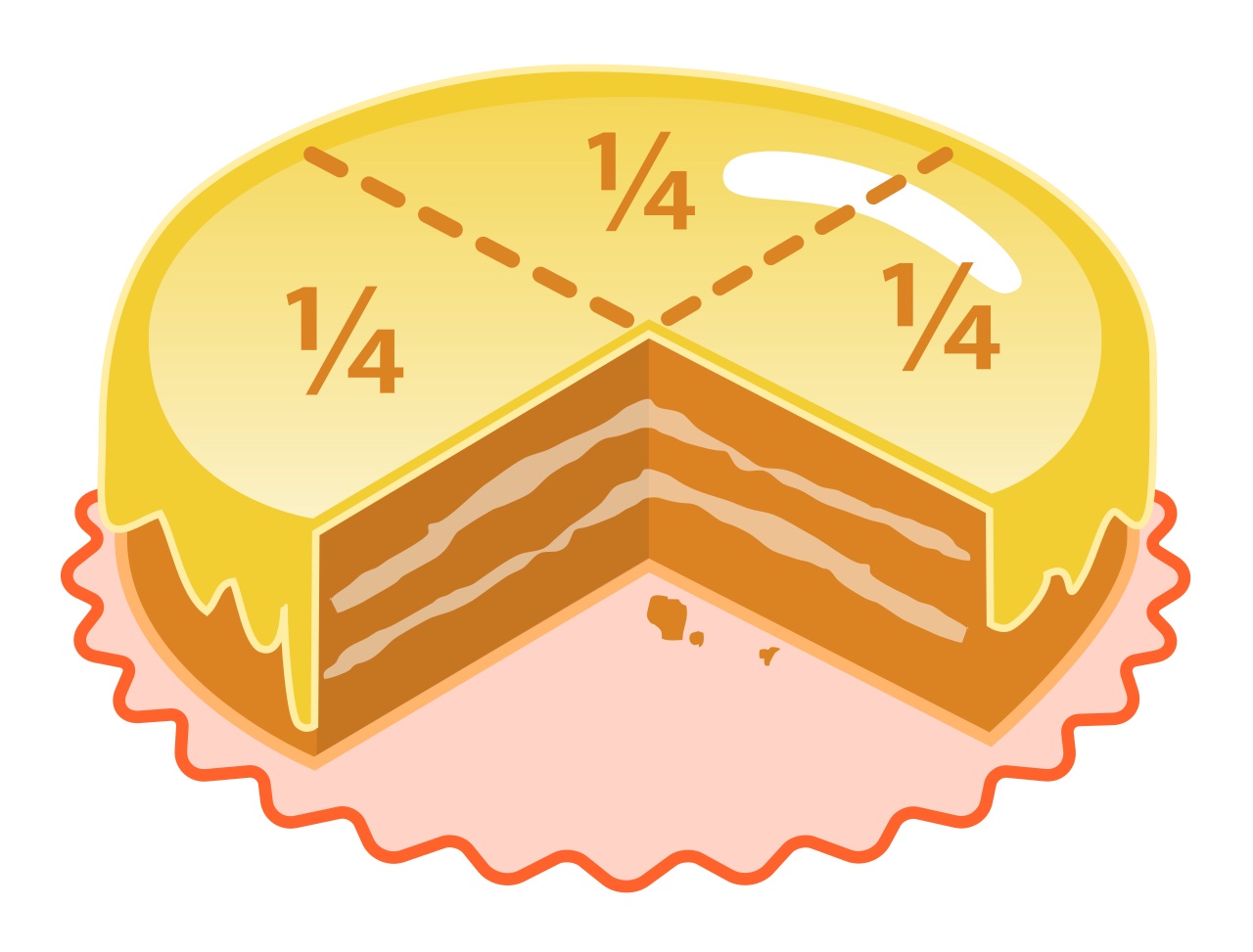
Fractions are numbers. They can name less than one whole, exactly one whole, or more than one whole. If a strip is divided into four equal lengths, one length is 1/4 of the strip. Three of those lengths make 3/4; five make 5/4, or 1 1/4 strips of the same size.
What the Numbers Mean
In 3/4, the denominator, 4, tells how many equal parts make one whole. The numerator, 3, tells how many of those parts are counted. Keep the whole or measurement unit clear. A quarter of a large sheet and a quarter of a small sheet need not be the same physical size.
Fractions on a Number Line
Divide the distance from 0 to 1 into four equal intervals. The first tick after 0 is 1/4, then 2/4, 3/4 and 4/4. Since 4/4 equals 1, the next quarter is 5/4, or 1 1/4. Zero quarters is 0/4, which equals 0.
Different Names, Same Number
The fractions 1/2, 2/4 and 4/8 name the same point on a number line. They are equivalent. Splitting each half into two equal pieces changes the number of pieces and their size, but not the amount represented by two quarters.
Adding Measured Amounts
A 1/4-meter strip and a 2/4-meter strip placed end to end have length 3/4 meter. We add the number of quarter-meter parts: 1/4 + 2/4 = 3/4. The denominator stays 4 because each part is still a quarter meter. Adding the denominators would change the size of the parts.
Repeated measurements still describe separate objects. Two strips that are each 3/4 meter long have combined length 6/4 meters, or 1 1/2 meters. A count of two strips is different from their total length.
Try It with Data
In a measurement line plot, each X can stand for one measured object. Its position names a length; the number of marks in a stack counts objects of that length. Use every mark when finding a combined length.
Build a fractional measurement line plot, then make your own plot from a new data set.

You finished the article! Great job!