
Wikimedia Commons
Ancient Greek Democracy
Ancient Greek Democracy
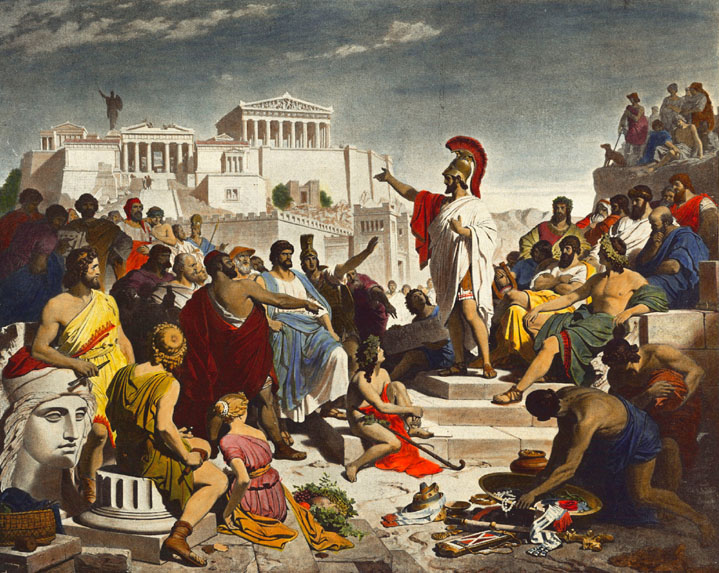
The city of Athens created one of the first democracies in the world about 2,500 years ago. In this new system, citizens could vote on laws and government decisions. This was very different from other places where kings or tyrants ruled. Athenian democracy inspired democracies around the world.
How It Worked
In Athens, male citizens gathered in an assembly to vote on laws. Every citizen had one vote, and decisions were made by majority rule. A council of 500 members was chosen by lottery each year. Citizens could also vote to banish a dangerous leader through a process called ostracism.
Limits of Athenian Democracy
Not everyone could participate in Athenian democracy. Women, enslaved people, and foreigners could not vote. Only about 10 to 20 percent of the population could vote. Despite these limits, Athens's experiment with democracy was a groundbreaking idea that influenced the entire world.
More to Know
The word democracy joins the Greek words demos (people) and kratos (power). Cleisthenes' reforms around 508 BCE are often seen as the start of Athenian democracy. Many officials, including the Council of 500 and jurors, were chosen by lot so many citizens had a turn. Citizens could also vote to send a powerful person away for ten years, writing names on pieces of broken pottery called ostraka; that is where ostracism comes from. Athens had direct democracy, while Canada and the United States elect representatives.
Fun Facts
- Citizens voted by raising their hands or placing stones in different containers.
- The word "ostracism" comes from the Greek word for a piece of pottery used in voting.
- Athens's democracy lasted for about 200 years before being taken over by other powers.
Did You Know?
In ostracism, citizens wrote the name of the person they wanted to banish on a piece of broken pottery, and the person with the most votes had to leave Athens for ten years.

You finished the article! Great job!